

Many landlords think about their next mortgage in simple terms.
What is the property worth?
How much is outstanding on the current mortgage?
What rent is being received?
What interest rate is available?
Those are all important questions, but there is another issue that can have a major impact on the outcome of a buy-to-let mortgage or remortgage: rental stress testing.
For many landlords, rental stress testing is one of the least understood parts of the mortgage process. It can affect how much a landlord can borrow, which lenders may be available, whether equity can be released and whether a remortgage is as straightforward as expected.
At NetRent, we have worked with landlords for almost 23 years. We understand that the buy-to-let mortgage market has become more criteria-driven and that landlords need to look beyond the headline rate. Rental stress testing is a key part of that wider picture.
If your mortgage deal ends in the next 3 to 6 months, or if you are planning to buy another rental property, understanding how rental stress testing may affect you is essential.
What Is Rental Stress Testing?
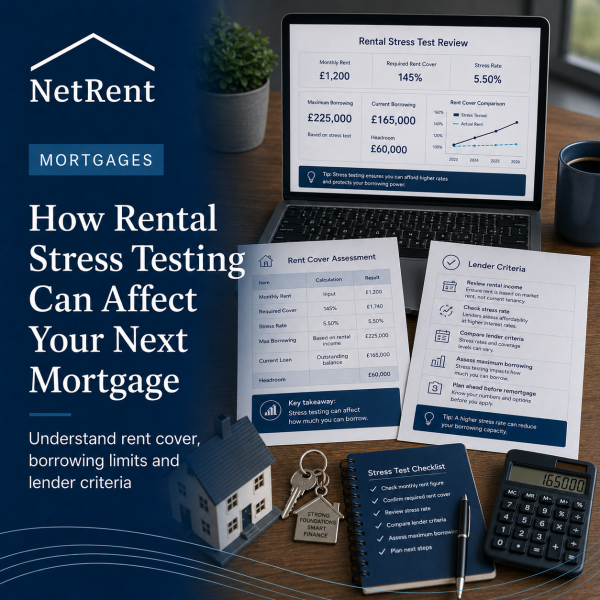
Rental stress testing is the way lenders assess whether the rental income from a property is strong enough to support the mortgage borrowing.
In simple terms, the lender looks at the expected or actual rent and compares it against the mortgage payment using their own calculation. The purpose is to check that the rent provides enough cover, even if interest rates are higher than the actual product rate or if the lender wants to build in a margin of safety.
This is different from simply looking at the rent you receive each month and comparing it with the mortgage payment you expect to make.
A landlord may feel that a property is profitable. The rent may cover the current mortgage. The tenant may pay reliably. The property may have performed well for years.
However, the lender will still apply its own test.
That is where landlords can sometimes be caught out.
Why Stress Testing Matters More in a Higher Rate Market
Rental stress testing becomes particularly important when interest rates are higher.
When rates were lower, many properties could pass lender calculations more easily. As rates rise, the assumed cost of borrowing used in lender assessments can also become more demanding. This can reduce the amount a landlord is able to borrow, even where the property itself has not changed.
For landlords coming off older, lower-rate fixed deals, this can be a shock.
A property that previously supported a certain mortgage amount may not support the same level of borrowing under today’s lender calculations. That can affect a remortgage, especially where the landlord wants to refinance at the same balance, release equity or move to a different lender.
This does not automatically mean there is no solution, but it does mean the case needs to be reviewed early.
Different lenders use different calculations, and different products may produce different outcomes. The important point is that landlords should not assume that yesterday’s mortgage approval guarantees tomorrow’s remortgage result.
Rental Income Is Not Assessed in Isolation
A common mistake is assuming that if the rent is high enough in practical terms, the mortgage should be straightforward.
In reality, lenders may consider several factors alongside the rent.
These can include the loan amount, the interest rate environment, the product selected, the landlord’s tax position, whether the property is owned personally or through a limited company, the loan-to-value, the type of property and the lender’s own appetite at the time of application.
This means two landlords receiving the same rent on similar properties may not necessarily receive the same lending outcome.
It also means that the lowest headline rate is not always the most useful route if the lender’s stress test does not work for the borrowing required. A slightly different product or lender may sometimes fit the case better, even if the headline rate is not the only attraction.
For landlords, the mortgage decision needs to be practical as well as competitive.
How Stress Testing Can Affect Remortgaging
Rental stress testing can affect a remortgage in several ways.
First, it may limit the amount that can be borrowed. If the lender’s calculation says the rent does not provide enough cover, the landlord may not be able to remortgage at the desired level with that lender.
Second, it may affect whether equity can be released. A landlord may have strong equity in the property, but if the rent does not support the higher borrowing, the lender may restrict the amount available.
Third, it may influence which lenders are suitable. Some lenders may be more flexible than others, depending on the property, rent, ownership structure and wider circumstances.
Fourth, it may make timing more important. If the current deal is about to end and the landlord discovers late that rental stress testing is an issue, there may be less time to explore alternative routes.
This is why NetRent encourages landlords to start the remortgage conversation 3 to 6 months before their current deal ends.
How Stress Testing Can Affect a New Purchase
Rental stress testing is just as important when buying another rental property.
Before making an offer, landlords should understand whether the expected rent is likely to support the borrowing they need. A property may look attractive because of its price, location or potential, but the mortgage position still needs to work.
This is especially important where landlords are buying at auction, considering a property that needs work, reviewing an HMO, looking at a limited company purchase or planning to raise the maximum possible borrowing.
If the rent does not support the loan required, the landlord may need a larger deposit, a different lender, a different product or a different funding route.
Speaking to NetRent before committing to a purchase can help landlords understand the likely lending position before they are under pressure.
Why Early Planning Gives Landlords More Options
The earlier rental stress testing is reviewed, the more time there is to consider the options.
There may be several possible routes. A different lender may apply a different calculation. A different product may affect the result. The landlord may need to review the loan amount, deposit level, rent, ownership structure or timing.
In some cases, the property may still fit standard buy-to-let lending. In others, a more specialist approach may be needed.
What landlords should avoid is discovering the problem too late.
If a mortgage deal is ending soon, the landlord may have limited time before moving onto a higher reversion rate. If a purchase is already underway, delay can create pressure. If an auction completion date is fixed, the consequences of not having the right finance route can be serious.
Early review does not guarantee a particular outcome, but it gives landlords more control.
Stress Testing Is Part of the Bigger Mortgage Picture
Rental stress testing should not be viewed in isolation. It sits alongside the wider mortgage decision.
Landlords also need to consider rates, fees, early repayment charges, product length, valuation, legal process, lender criteria, property condition and future plans.
For example, a landlord may want the lowest possible monthly payment now, but also needs flexibility to refinance again later. Another landlord may want to release equity but must ensure the rent supports the additional borrowing. Another may be more concerned with certainty and long-term cash flow.
The right mortgage route should take all of these issues into account.
At NetRent, we understand that landlords need more than a basic rate comparison. They need a practical review of what is likely to work for their property, their income and their plans.
Speak to NetRent Before Stress Testing Becomes a Problem
Rental stress testing can be one of the most important parts of a buy-to-let mortgage or remortgage application. It can affect borrowing, lender choice, equity release and the overall direction of the application.
Landlords who understand this early are in a stronger position.
If your mortgage deal ends in the next 3 to 6 months, or if you are planning to buy another rental property, speak to NetRent now. We can help you start the conversation early and review the issues that may affect your next mortgage decision.
Call NetRent today on 01352 721300
Email: mortgages@netrent.co.uk
Do not wait until the application stage to find out whether the rent supports the borrowing you need. Start early, understand your position and give yourself more time to explore the right route.
Disclaimer
NetRent does not provide legal advice. This article represents our general understanding of the landlord mortgage and rental property market and is provided for information only.